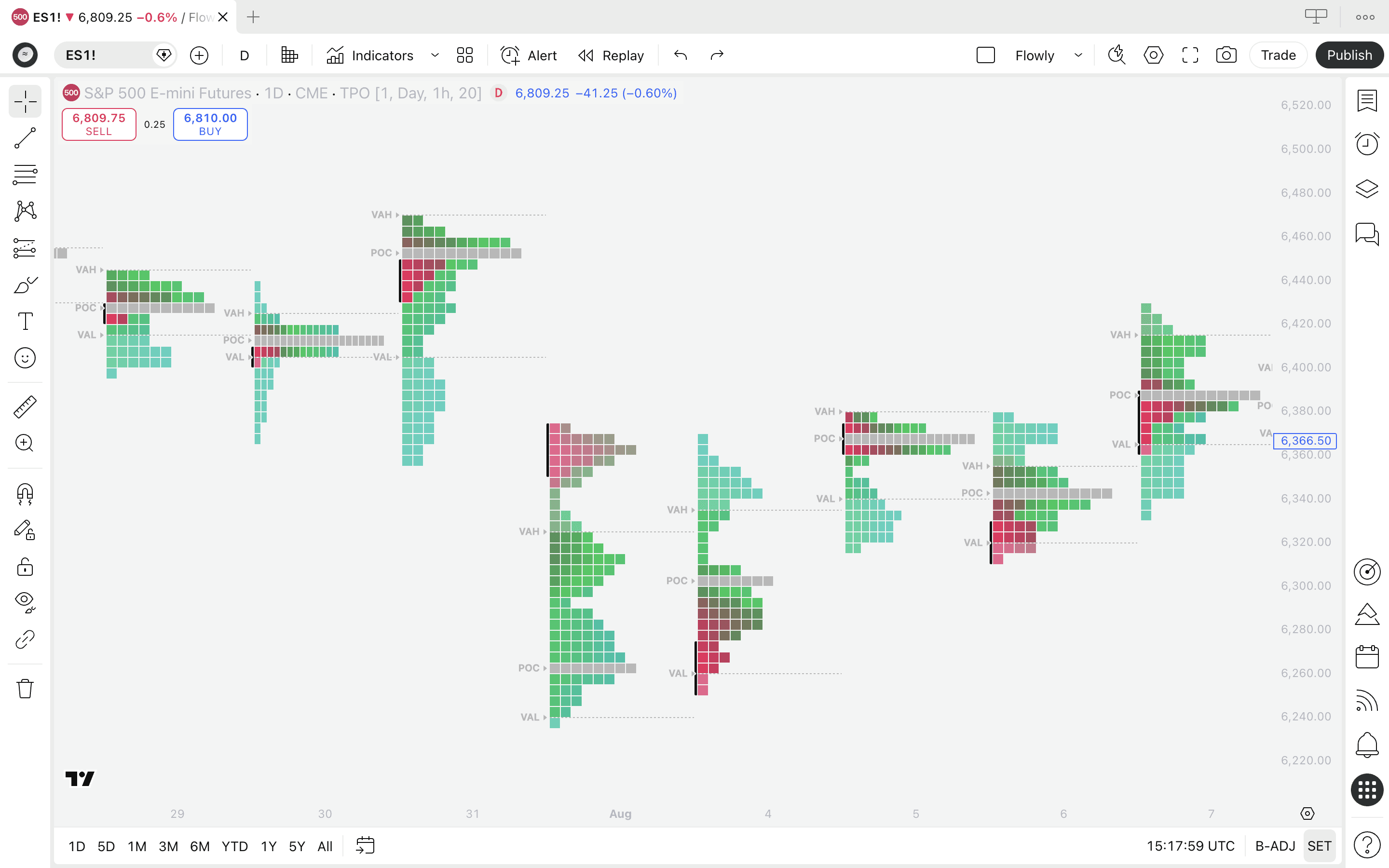

How accurate is TradingView orderflow?
Precision matters, especially in orderflow trading. Each order hitting the bid or ask forms the core benefit of orderflow to begin with: seeing how price formed, not just the form.
The beauty of TradingView's orderflow is simplicity and seamless integration. No data feeds that cost extra, no latency issues, no configurations. It just works on any market, any timeframe and any device.
But that convenience comes with a trade-off in how the data is processed. This is where the whole "reliable vs. unreliable" debate lives.
How TradingView calculates orderflow?
Whereas native orderflow platforms record literally every single buy and sell order hitting the orderbook, TradingView uses something called timeframe based estimation.
On native orderflow platforms, whenever price moves even the slightest amount, its volume and corresponding price level are stored and displayed on tools like volume profile.
TradingView takes a different approach, calculating orderflow using lower timeframe price data. For example, on 4 hour chart, TradingView would check all 240x1 minute candles (240 minutes = 4 hour) inside the higher timeframe price move, store it and display it.
The calculation logic on native orderflow platforms and TradingView is actually largely the same, but key difference lies in level of detail.
Volume tick based orderflow
A volume tick update is one single executed trading order and the amount of volume it carries. All orders, whatever size, create an update like this.
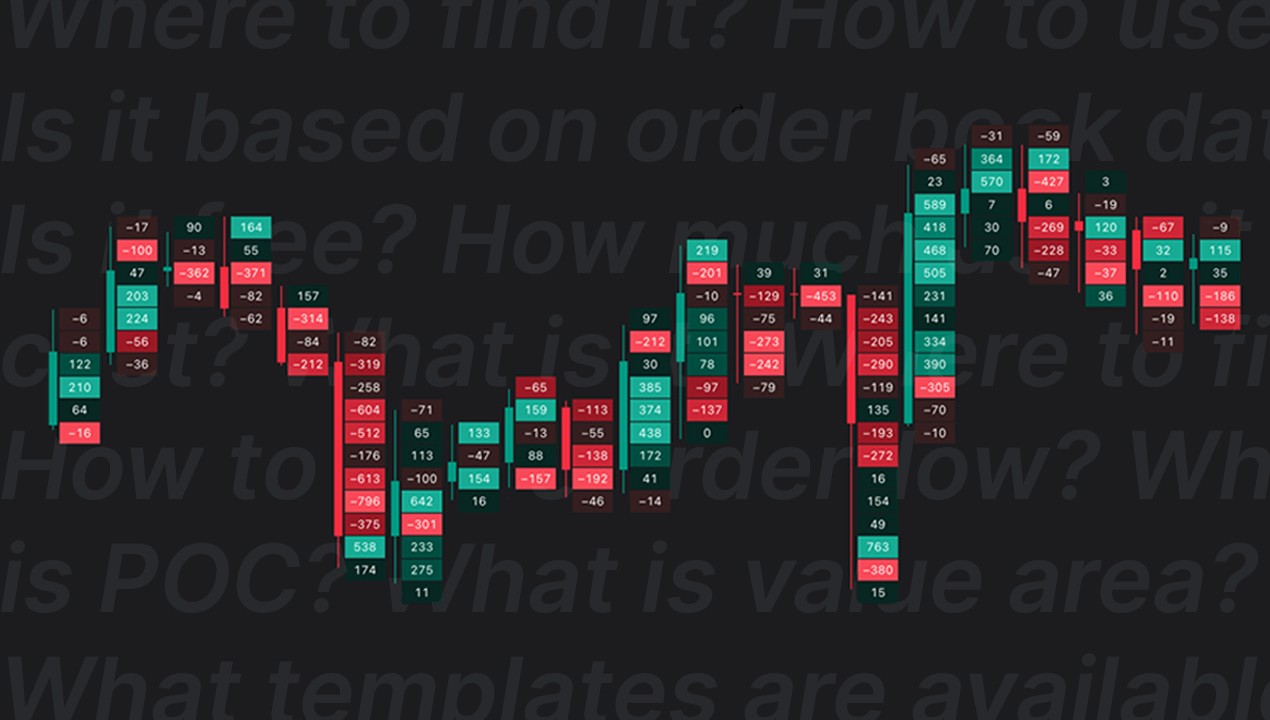
Volume tick data is ultra precise, because even the slightest penny moving through the books gets recorded and is used for assessing intent of traders through various calculations (such as buy volume vs. sell volume).
Timeframe based orderflow
When we break down a higher timeframe chart into lower timeframe price moves (like in 4 hour -> 240x1 minute), we also get much greater detail - but not as much as with volume tick data.
Since TradingView doesn't offer volume tick data by default, it simply assumes all the volume traded at lower timeframe candle occurred at its closing price.
In reality, some occurred at the close, some at the low, some at the high and so on. However, since 1 minute price moves are generally speaking so small, the difference is practically speaking negligible.
Assuming all volume traded at $300 (closing price) is virtually the same as accurately mapping volume flows between $299.70 (low price) and $300.40 (high price). For most traders and most charts anyway.
Volume tick noise
Here's the catch with ultra precision, it does not automatically mean useful. It is accurate, but not necessarily readable.
When you display every single tick on a volume profile or footprint, you often end up with tiny volume clusters meshing together, muddying the underlying signal (like sellers being absorbed).
That is why even native orderflow platforms like Sierra Chart and ATAS offer bundling volume tick updates together. Instead of recording every individual order as its own data point, you might set the platform to bundle 100, 200 or 1000 ticks into a one single "volume update".
This is more often than not a must-do, rather than could-do. In volatile markets, the noise can ruin your read.
How accurate is TradingView orderflow?
Precision matters, especially in orderflow trading. Each order hitting the bid or ask forms the core benefit of orderflow to begin with: seeing how price formed, not just the form.
The beauty of TradingView's orderflow is simplicity and seamless integration. No data feeds that cost extra, no latency issues, no configurations. It just works on any market, any timeframe and any device.
But that convenience comes with a trade-off in how the data is processed. This is where the whole "reliable vs. unreliable" debate lives.
How TradingView calculates orderflow?
Whereas native orderflow platforms record literally every single buy and sell order hitting the orderbook, TradingView uses something called timeframe based estimation.
On native orderflow platforms, whenever price moves even the slightest amount, its volume and corresponding price level are stored and displayed on tools like volume profile.
TradingView takes a different approach, calculating orderflow using lower timeframe price data. For example, on 4 hour chart, TradingView would check all 240x1 minute candles (240 minutes = 4 hour) inside the higher timeframe price move, store it and display it.
The calculation logic on native orderflow platforms and TradingView is actually largely the same, but key difference lies in level of detail.
Volume tick based orderflow
A volume tick update is one single executed trading order and the amount of volume it carries. All orders, whatever size, create an update like this.
Volume tick data is ultra precise, because even the slightest penny moving through the books gets recorded and is used for assessing intent of traders through various calculations (such as buy volume vs. sell volume).
Timeframe based orderflow
When we break down a higher timeframe chart into lower timeframe price moves (like in 4 hour -> 240x1 minute), we also get much greater detail - but not as much as with volume tick data.
Since TradingView doesn't offer volume tick data by default, it simply assumes all the volume traded at lower timeframe candle occurred at its closing price.
In reality, some occurred at the close, some at the low, some at the high and so on. However, since 1 minute price moves are generally speaking so small, the difference is practically speaking negligible.
Assuming all volume traded at $300 (closing price) is virtually the same as accurately mapping volume flows between $299.70 (low price) and $300.40 (high price). For most traders and most charts anyway.
Volume tick noise
Here's the catch with ultra precision, it does not automatically mean useful. It is accurate, but not necessarily readable.
When you display every single tick on a volume profile or footprint, you often end up with tiny volume clusters meshing together, muddying the underlying signal (like sellers being absorbed).
That is why even native orderflow platforms like Sierra Chart and ATAS offer bundling volume tick updates together. Instead of recording every individual order as its own data point, you might set the platform to bundle 100, 200 or 1000 ticks into a one single "volume update".
This is more often than not a must-do, rather than could-do. In volatile markets, the noise can ruin your read.
Myths and facts of TradingView orderflow
Now that we know how the calculations work under the hood, let's address the elephant in the room: is TradingView's orderflow real or not?
It's a valid concern given the different calculation methods, but takes on the topic often lack nuance. Here's what actually holds up and what doesn't.
Myth: TradingView's orderflow is unreliable
TradingView's orderflow is an estimation and therefore not "true orderflow" in the truest sense of the word. But here's the curveball that follows: that estimation is very accurate.
In our side-by-side comparisons with tick-based platforms, the high volume nodes and low volume nodes consistently land in the same structural zones.
As long as the amount of lower timeframe price data used in the calculation is high enough (for example 30 candles), a fair and accurate representation of orderflow is formed. With way less noise.
Fact: Exact volume values are unreliable
What you can't trust is the exact numbers, like "460K shares traded at $21.50". This level of accuracy can only be achieved on native orderflow platforms with exchange data feeds.
Whether you need to know the exact amount or not is another thing though. Most traders are arguably well off by just knowing where activity is high and where it's low.
Tread with caution: Volume delta
Volume delta, meaning difference between buy and sell volume, becomes a little bit tricky on TradingView.
On native orderflow platforms, volume delta is calculated based on whether those hundreds or potentially thousands of volume tick updates hit sell-side or buy-side of the orderbook in an exchange.
This is where surgical level precision actually matters. Whereas price level doesn't change as much between a rapid feed of volume tick updates, the executing side does.
On TradingView, volume delta is calculated by assuming all up moves on lower timeframe charts are buy volume and all down moves sell volume.
What you get could be considered a visualization of lower timeframe buy and sell pressure. But that is not the same thing as true volume delta. It cannot be no matter how you twist it.
Myths and facts of TradingView orderflow
Now that we know how the calculations work under the hood, let's address the elephant in the room: is TradingView's orderflow real or not?
It's a valid concern given the different calculation methods, but takes on the topic often lack nuance. Here's what actually holds up and what doesn't.
Myth: TradingView's orderflow is unreliable
TradingView's orderflow is an estimation and therefore not "true orderflow" in the truest sense of the word. But here's the curveball that follows: that estimation is very accurate.
In our side-by-side comparisons with tick-based platforms, the high volume nodes and low volume nodes consistently land in the same structural zones.
As long as the amount of lower timeframe price data used in the calculation is high enough (for example 30 candles), a fair and accurate representation of orderflow is formed. With way less noise.
Fact: Exact volume values are unreliable
What you can't trust is the exact numbers, like "460K shares traded at $21.50". This level of accuracy can only be achieved on native orderflow platforms with exchange data feeds.
Whether you need to know the exact amount or not is another thing though. Most traders are arguably well off by just knowing where activity is high and where it's low.
Tread with caution: Volume delta
Volume delta, meaning difference between buy and sell volume, becomes a little bit tricky on TradingView.
On native orderflow platforms, volume delta is calculated based on whether those hundreds or potentially thousands of volume tick updates hit sell-side or buy-side of the orderbook in an exchange.
This is where surgical level precision actually matters. Whereas price level doesn't change as much between a rapid feed of volume tick updates, the executing side does.
On TradingView, volume delta is calculated by assuming all up moves on lower timeframe charts are buy volume and all down moves sell volume.
What you get could be considered a visualization of lower timeframe buy and sell pressure. But that is not the same thing as true volume delta. It cannot be no matter how you twist it.
Pros and cons of TradingView orderflow
There are the good, bad and the ugly no matter what you look at - cost, usability, ease and purpose. How much each weighs depends quite a bit on how you trade.
Here's a few pros and cons to help you decide if TradingView's orderflow offering is for you.
Pro: Simple and modern
Native orderflow platforms can look like spreadsheets, designed by engineers for engineers. TradingView puts footprint charts, volume profiles and TPO charts inside the same interface you already use. Click, apply, done. A tool you enjoy using is a tool you'll actually use.
Pro: No data feeds
Native orderflow platforms require separate data feed subscriptions (Rithmic, CQG, dxFeed) running $15–$100+/month and some initial configuration. Once set up, they run in the background, but the cost and setup are real considerations. TradingView delivers orderflow data for all charts and timeframes without hiccups and annoying data limitations.
Pro: Accurate for most use cases
If you simply want to read the overall participation of traders and key flows, TradingView's timeframe-based estimation lands in the same places as native platforms. The accuracy gap only matters when you need exact volume delta or need to inspect individual orders. Most traders probably don't, even if they think they do.
Pro: Everything in one place
Hopping between TradingView for charting, Sierra Chart for orderflow, a separate DOM and a news terminal can feel more cluttering than clarifying. All in one tab keeps you focused.
Con: Estimate, not exact
TradingView reconstructs orderflow from lower timeframe price data. For knowing exactly how many contracts traded with bulletproof accuracy, native platforms with exchange data feeds win.
Con: Volume Delta is iffy
TradingView estimates volume delta by labeling up-closes as buys and down-closes as sells. On trending days, close enough. On choppy sessions with rapid reversals, the gap gets wide. If net volume won't suffice for your needs, choose a native orderflow platform.
Pros and cons of TradingView orderflow
There are the good, bad and the ugly no matter what you look at - cost, usability, ease and purpose. How much each weighs depends quite a bit on how you trade.
Here's a few pros and cons to help you decide if TradingView's orderflow offering is for you.
Pro: Simple and modern
Native orderflow platforms can look like spreadsheets, designed by engineers for engineers. TradingView puts footprint charts, volume profiles and TPO charts inside the same interface you already use. Click, apply, done. A tool you enjoy using is a tool you'll actually use.
Pro: No data feeds
Native orderflow platforms require separate data feed subscriptions (Rithmic, CQG, dxFeed) running $15–$100+/month and some initial configuration. Once set up, they run in the background, but the cost and setup are real considerations. TradingView delivers orderflow data for all charts and timeframes without hiccups and annoying data limitations.
Pro: Accurate for most use cases
If you simply want to read the overall participation of traders and key flows, TradingView's timeframe-based estimation lands in the same places as native platforms. The accuracy gap only matters when you need exact volume delta or need to inspect individual orders. Most traders probably don't, even if they think they do.
Pro: Everything in one place
Hopping between TradingView for charting, Sierra Chart for orderflow, a separate DOM and a news terminal can feel more cluttering than clarifying. All in one tab keeps you focused.
Con: Estimate, not exact
TradingView reconstructs orderflow from lower timeframe price data. For knowing exactly how many contracts traded with bulletproof accuracy, native platforms with exchange data feeds win.
Con: Volume Delta is iffy
TradingView estimates volume delta by labeling up-closes as buys and down-closes as sells. On trending days, close enough. On choppy sessions with rapid reversals, the gap gets wide. If net volume won't suffice for your needs, choose a native orderflow platform.
Frequently Asked Questions
Orderflow on TradingView is still relatively new and there is a lot of confusion (and straight up misinformation) floating around the internet. Here are the three questions we see come up the most.
Does TradingView have Depth of Market (DOM)?
Yes, once you connect a supported broker to the platform. And it is real level 2 data, you will see inside the orderbook in real-time. But keep in mind that's the orderbook of the connected broker specifically.
Does TradingView Volume Footprint have net volume?
Yes. TradingView's Volume Footprint includes a net volume template that displays total volume traded at each price level. This is significantly more reliable than the delta templates, because it doesn't depend on estimating whether volume was buy or sell - it just shows you how much traded where.
Is TradingView a good replacement for Bookmap and ATAS?
Bookmap and ATAS are "specialist" orderflow software with raw exchange data, true volume delta and DOM visualization that TradingView cannot replicate. If your strategy revolves around reading the orderbook or precise delta-divergence setups, those platforms still do that better. For traders who use orderflow as one part of a broader toolkit, TradingView gives you most of the capability with little to none operational friction.
Frequently Asked Questions
Orderflow on TradingView is still relatively new and there is a lot of confusion (and straight up misinformation) floating around the internet. Here are the three questions we see come up the most.
Does TradingView have Depth of Market (DOM)?
Yes, once you connect a supported broker to the platform. And it is real level 2 data, you will see inside the orderbook in real-time. But keep in mind that's the orderbook of the connected broker specifically.
Does TradingView Volume Footprint have net volume?
Yes. TradingView's Volume Footprint includes a net volume template that displays total volume traded at each price level. This is significantly more reliable than the delta templates, because it doesn't depend on estimating whether volume was buy or sell - it just shows you how much traded where.
Is TradingView a good replacement for Bookmap and ATAS?
Bookmap and ATAS are "specialist" orderflow software with raw exchange data, true volume delta and DOM visualization that TradingView cannot replicate. If your strategy revolves around reading the orderbook or precise delta-divergence setups, those platforms still do that better. For traders who use orderflow as one part of a broader toolkit, TradingView gives you most of the capability with little to none operational friction.
The final verdict
TradingView's orderflow is not a mediocre compromise, but a genuinely capable set of tools for structural accuracy, which is what most traders care about.
Where the volume concentrated, where big positions opened and where traders got trapped are all well within reach on TradingView. The limitations are real though and TradingView doesn't pretend otherwise.
TradingView docs clearly say the orderflow data is an estimation, not a tick-by-tick recording. Volume delta on TradingView in particular is a challenging estimation due to lack of bid/ask data.
If you use volume delta as a rough directional filter alongside structure, it can still add value. Other than that, chances are you'll be fully fine with just TradingView, even for day trading.
The best orderflow tool is one you understand, trust and actually use. Precision matters. But so does knowing how much of it you actually need.
The final verdict
TradingView's orderflow is not a mediocre compromise, but a genuinely capable set of tools for structural accuracy, which is what most traders care about.
Where the volume concentrated, where big positions opened and where traders got trapped are all well within reach on TradingView. The limitations are real though and TradingView doesn't pretend otherwise.
TradingView docs clearly say the orderflow data is an estimation, not a tick-by-tick recording. Volume delta on TradingView in particular is a challenging estimation due to lack of bid/ask data.
If you use volume delta as a rough directional filter alongside structure, it can still add value. Other than that, chances are you'll be fully fine with just TradingView, even for day trading.
The best orderflow tool is one you understand, trust and actually use. Precision matters. But so does knowing how much of it you actually need.